

Discrete ADC DIY Kit
Discrete ADC DIY Kit
This kit teaches you how analog-to-digital conversion actually works — built from discrete comparators, flip-flops, and logic gates instead of a black-box ADC chip. You get the board, every component, and a 37-page engineering design guide.
Skills you'll build
Couldn't load pickup availability


Skills you'll build
What's included
- PCB
- All electronic components — LM393N, 74HC74N, 74HC32N and all supporting parts
- Potentiometer — analog input control
- 8 × LEDs — binary output display
- Documentation — assembly guide and ADC theory
About this kit
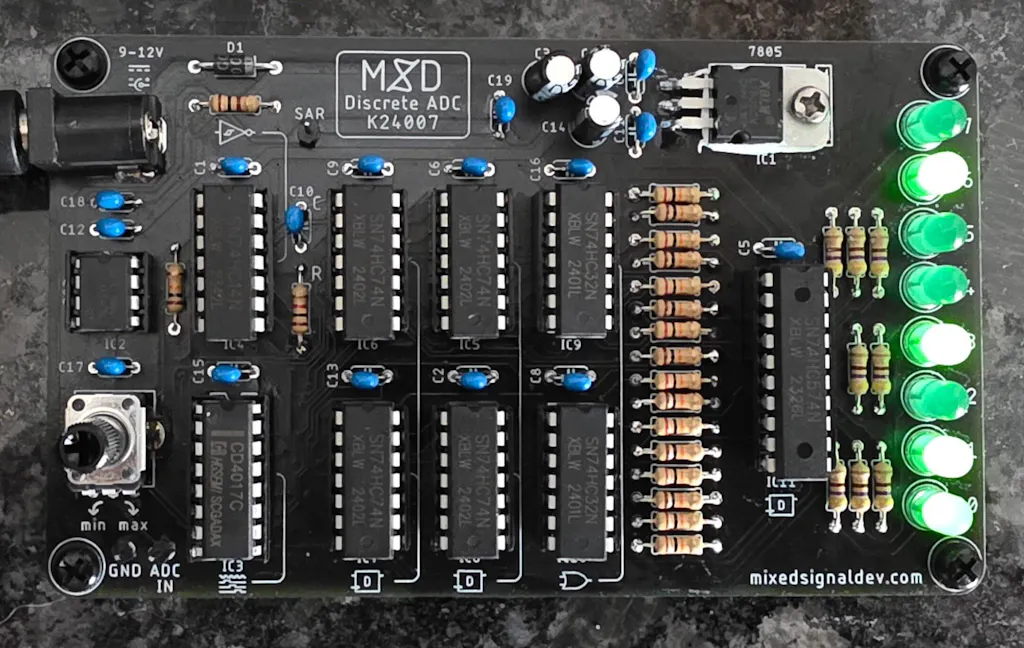
Have you ever wondered how analog signals become digital? With the Discrete ADC DIY Kit, you build your own 8-bit Analog to Digital Converter from scratch — using real discrete logic components instead of a single integrated ADC chip. Set the analog input with a potentiometer and watch the result appear live across 8 LEDs as an 8-bit binary value.
The circuit uses an LM393N dual comparator, 74HC74N dual D flip-flop, 74HC32N quad OR gate, and supporting logic to carry out the conversion — the same fundamental operations hidden inside every ADC IC, made visible and understandable.
All components are through-hole, making this kit accessible to anyone comfortable with basic soldering.
What you'll learn
- How analog-to-digital conversion works at the circuit level — not inside a black-box IC
- How a comparator circuit (LM393N) compares a voltage against a reference threshold
- How D flip-flops (74HC74N) store and propagate digital states through successive conversion stages
- How OR gates (74HC32N) combine logic signals in the ADC conversion chain
- How to read an 8-bit binary output from LEDs
- How discrete logic ICs combine to perform the same function hidden inside every ADC chip
- How rotating a potentiometer changes the analog input and shifts the binary LED output in real time
Prerequisites & difficulty
Technical specifications
FAQ
What is an ADC and why build one from discrete parts?
An ADC converts an analog voltage into a digital binary number. Building one from discrete components lets you see each stage of the conversion — the same process hidden inside every ADC IC, made visible.
What binary knowledge do I need?
You need to understand binary numbers — what each bit represents and how to read an 8-bit value. If you can count in binary up to 255, you're ready.
Is this suitable for beginners?
Intermediate level. Basic through-hole soldering experience is required. If you're new to soldering, start with the Soldering Practice Kit or BCD Counter first.
Browse the documentation
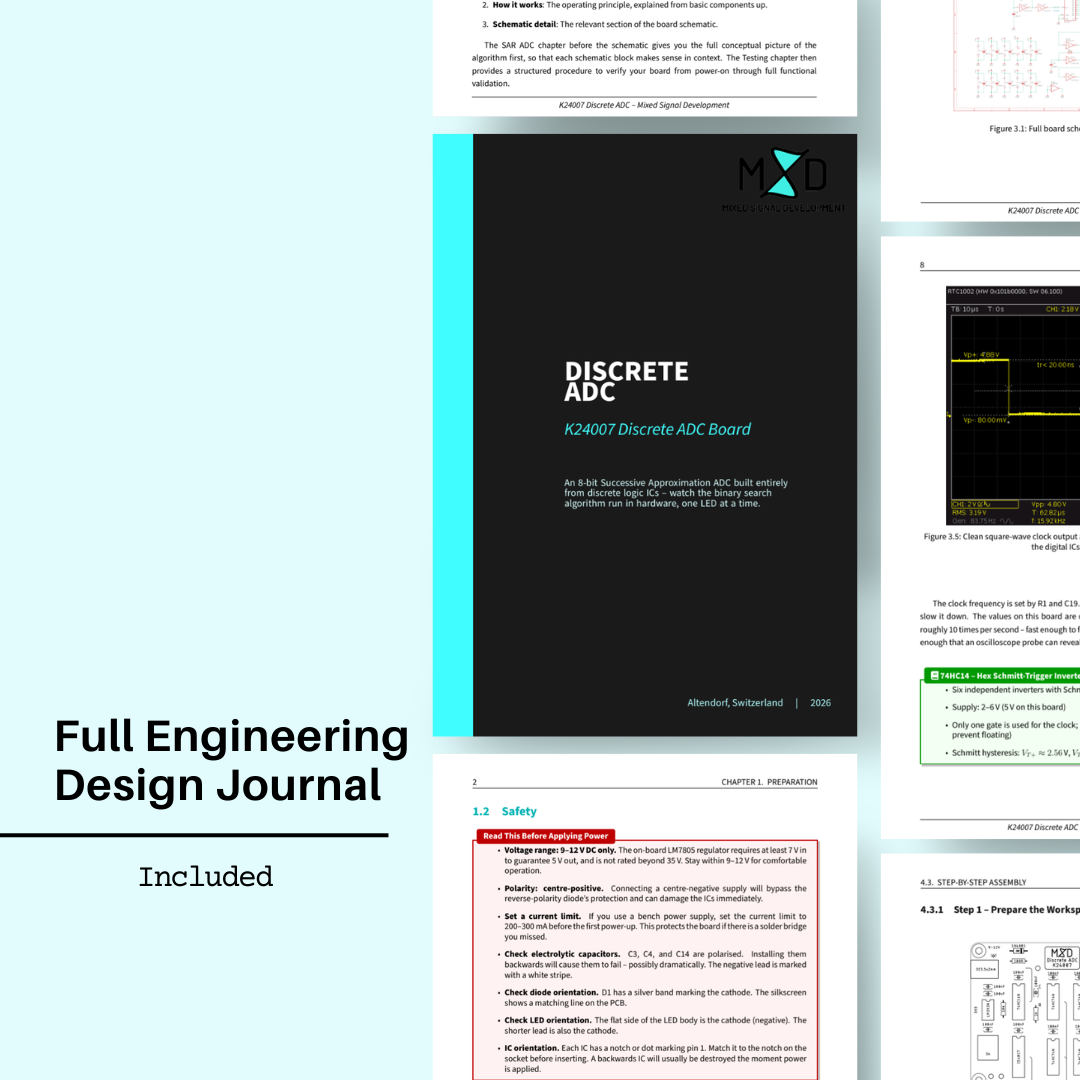
Every kit includes a full engineering design guide. Here's a preview.
Our approach
Want to see how our documentation is different?
Every MSD kit ships with an engineering design guide written by the person who designed the board. Not a pinout diagram — a real document.
Premium Engineering Files
Thank you for your purchase. Your files are ready to download.