


The Fundamental Skills Bundle
The Fundamental Skills Bundle
Couldn't load pickup availability


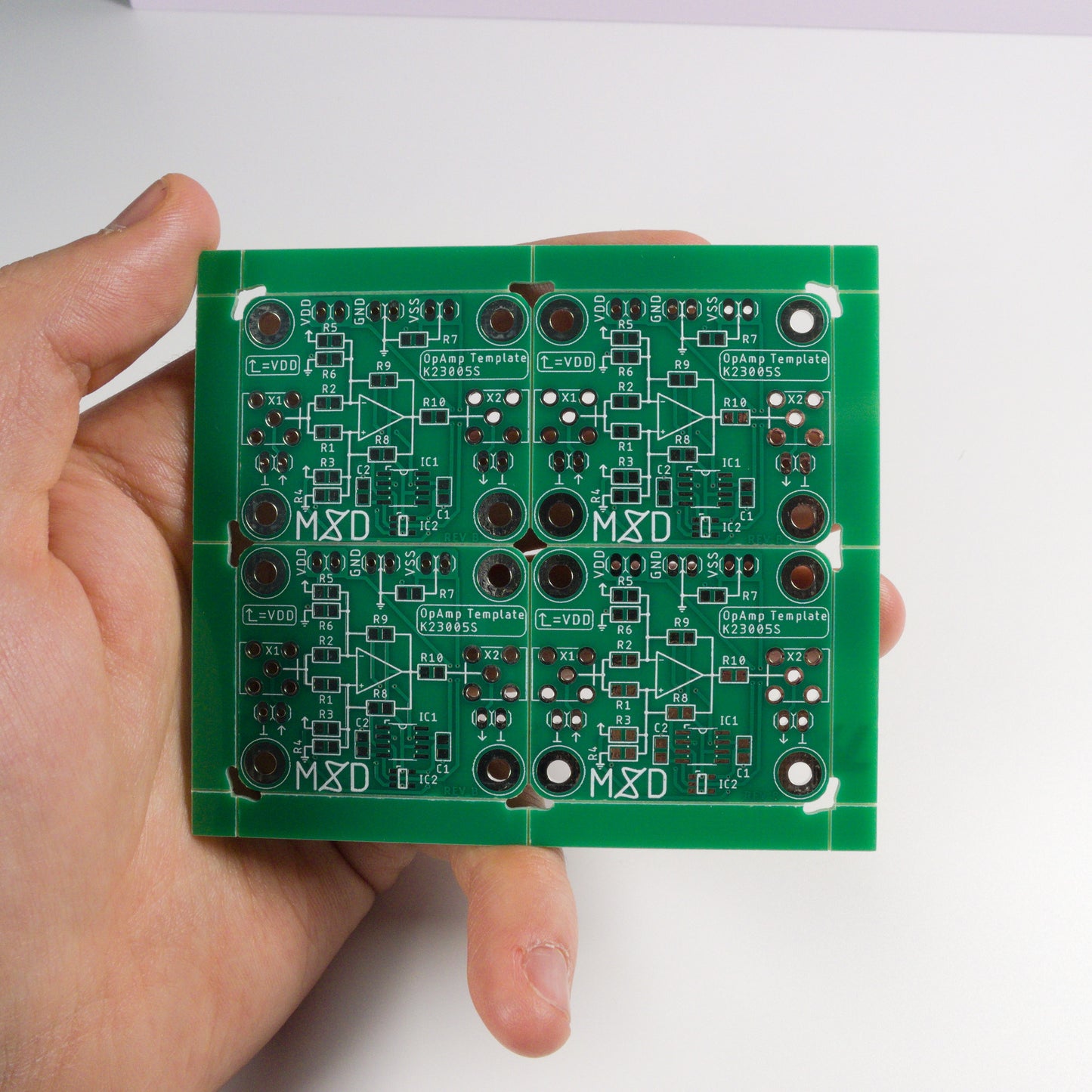
Build a microcontroller circuit from scratch. Then build a real instrument with it. Then learn the protocol that connects everything to everything. Three kits that actually go together.
Skills you'll build
What's included
- Soldering Practice PCB Kit — PCB + all through-hole components
- BCD Counter PCB Kit — PCB + 74LS90, 74LS47, 74LS42 ICs + all components
- OpAmp Template Educational Kit — PCB + LM358, LM321 op-amps + all components
- Assembly guides and circuit theory documentation for all three kits
About this kit
If you're starting from scratch and want to actually understand electronics — not just follow a step-by-step and hope it works — this is where I'd tell you to begin.
Three kits, in the order that makes sense. You build the physical skill first, then you do something with it, then you open up the analog side of things that most beginner tutorials never touch.
What's in the box
- Soldering Practice PCB Kit — A board designed specifically for building technique, not for making something that blinks. Mixed pad sizes, through-hole components, the kind of repetition that actually sticks. Worth doing properly before anything else.
- BCD Counter PCB Kit — Your first real digital logic circuit. A working counter built from 74-series ICs — no microcontroller, no firmware, just logic chips doing logic things. Clearer than any Arduino tutorial at explaining how digital electronics actually behave.
- OpAmp Template Educational Kit — An analog sandbox built around the LM358 and LM321. Wire it up as an amplifier, a comparator, a filter, an oscillator. This is the kit that introduces the half of electronics that software people tend to avoid.
Why this order
Soldering first — because bad joints will ruin every build that follows. The BCD Counter next — because understanding logic at the IC level, without a microcontroller doing the work for you, is genuinely useful. The OpAmp last — because analog design takes a different kind of thinking, and it's easier to absorb once your hands are already trained.
None of these kits are complicated. All of them teach something real.
Is this right for you?
Yes, if you're a complete beginner. Yes, if you've done some Arduino projects but want to understand what's actually happening underneath. No prior experience required — that's the whole point of starting with the Soldering Practice kit.
What you'll learn
- How to actually solder — technique, not just going through the motions
- How 74-series logic ICs work together to count, decode, and drive a display — without a microcontroller doing it for you
- How op-amps behave as amplifiers, comparators, filters, and oscillators — and when to reach for each one
- Why analog circuits matter even when everything seems to be digital
- How to get real value from a proper engineering design guide
Prerequisites & difficulty
Technical specifications
FAQ
Do all three kits ship together?
Yes — one order, one box.
Do I need a soldering iron?
Yes. A basic 25–40W iron with a fine tip is all you need. Not included.
Is this really for complete beginners?
Yes. The Soldering Practice kit exists specifically so you learn technique before anything else. It's the right starting point.
Does each kit come with documentation?
Yes. Every kit includes an assembly guide and an explanation of how the circuit actually works — not just a component list.
Our approach
Want to see how our documentation is different?
Every MSD kit ships with an engineering design guide written by the person who designed the board. Not a pinout diagram — a real document.
Kit Documentation
Purchase this bundle to unlock the premium engineering files for all three kits.